GAP-MLLM: Geometry-Aligned Pre-training for Activating 3D Spatial Perception in Multimodal Large Language Models

Jiaxin Zhang1,#, Junjun Jiang1,†, Haijie Li2, Youyu Chen1, Kui Jiang1, Dave Zhenyu Chen3

1Harbin Institute of Technology

2School of Electronic and Computer Engineering, Peking University

3Huawei

#This work was done during he was an intern at Huawei.

Corresponding author.

Overview

Geometry-aligned pre-training activates structural perception.

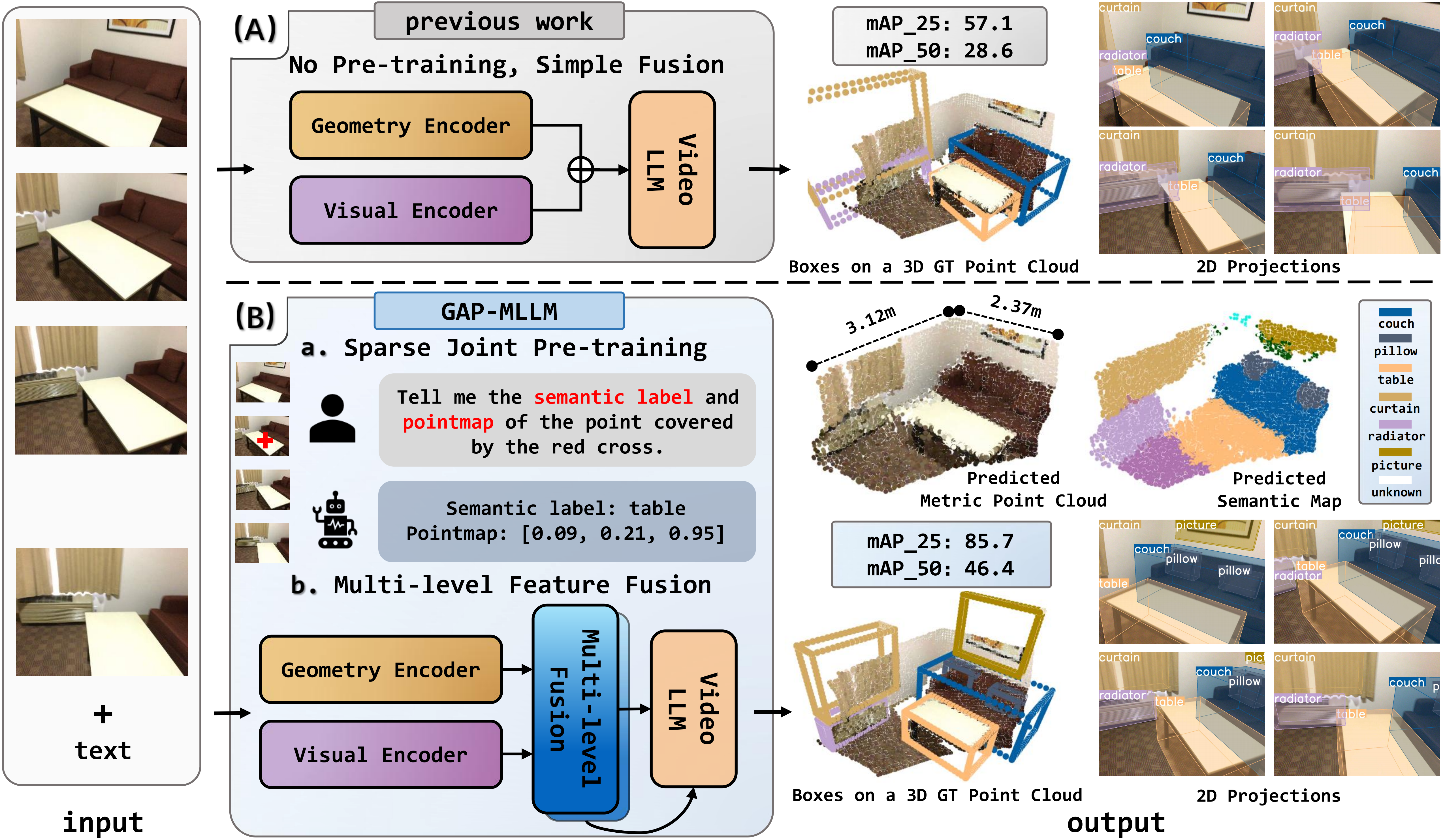
First page teaser figure from the GAP-MLLM paper

Abstract

MLLMs need geometry-aware activation before downstream adaptation.

Multimodal Large Language Models (MLLMs) demonstrate exceptional semantic reasoning but struggle with 3D spatial perception when restricted to pure RGB inputs. Despite leveraging implicit geometric priors from 3D reconstruction models, image-based methods still exhibit a notable performance gap compared to methods using explicit 3D data. We argue that this gap does not arise from insufficient geometric priors, but from a misalignment in the training paradigm: text-dominated fine-tuning fails to activate geometric representations within MLLMs. Existing approaches typically resort to naive feature concatenation and optimize directly for downstream tasks without geometry-specific supervision, leading to suboptimal structural utilization.

To address this limitation, we propose GAP-MLLM, a Geometry-Aligned Pre-training paradigm that explicitly activates structural perception before downstream adaptation. Specifically, we introduce a visual-prompted joint task that compels the MLLMs to predict sparse pointmaps alongside semantic labels, thereby enforcing geometric awareness. Furthermore, we design a multi-level progressive fusion module with a token-level gating mechanism, enabling adaptive integration of geometric priors without suppressing semantic reasoning. Extensive experiments demonstrate that GAP-MLLM significantly enhances geometric feature fusion and consistently enhances performance across 3D visual grounding, 3D dense captioning, and 3D video object detection tasks.

Method

Sparse joint supervision plus progressive geometry fusion.

01 / Architecture

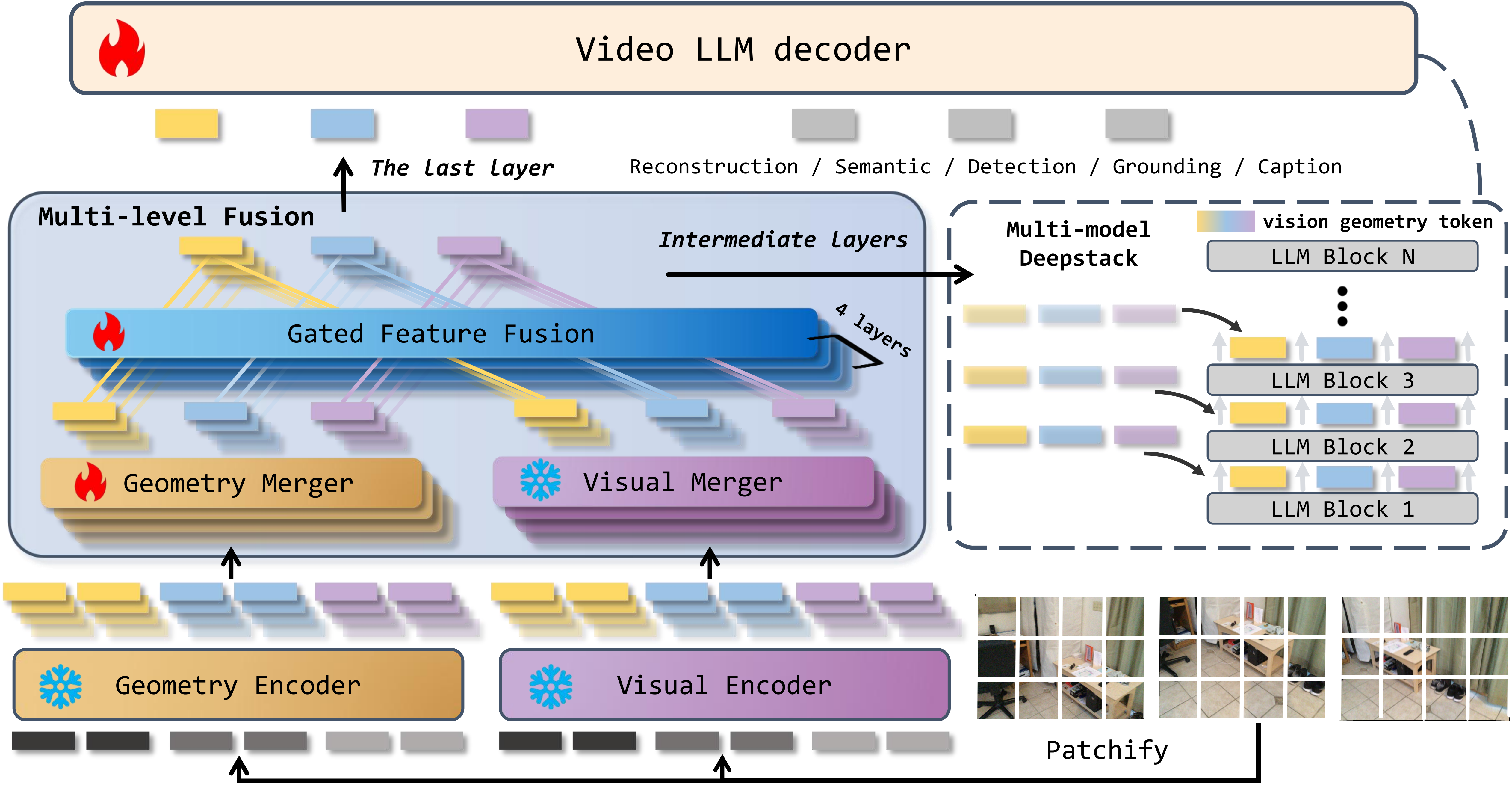
Multi-level progressive fusion with token-level gating.

GAP-MLLM couples visual tokens with geometry tokens across multiple intermediate layers. Instead of simple late fusion, the architecture progressively injects structural priors and uses adaptive gates to balance geometry and semantics token by token.

GAP-MLLM architecture diagram
02 / Training

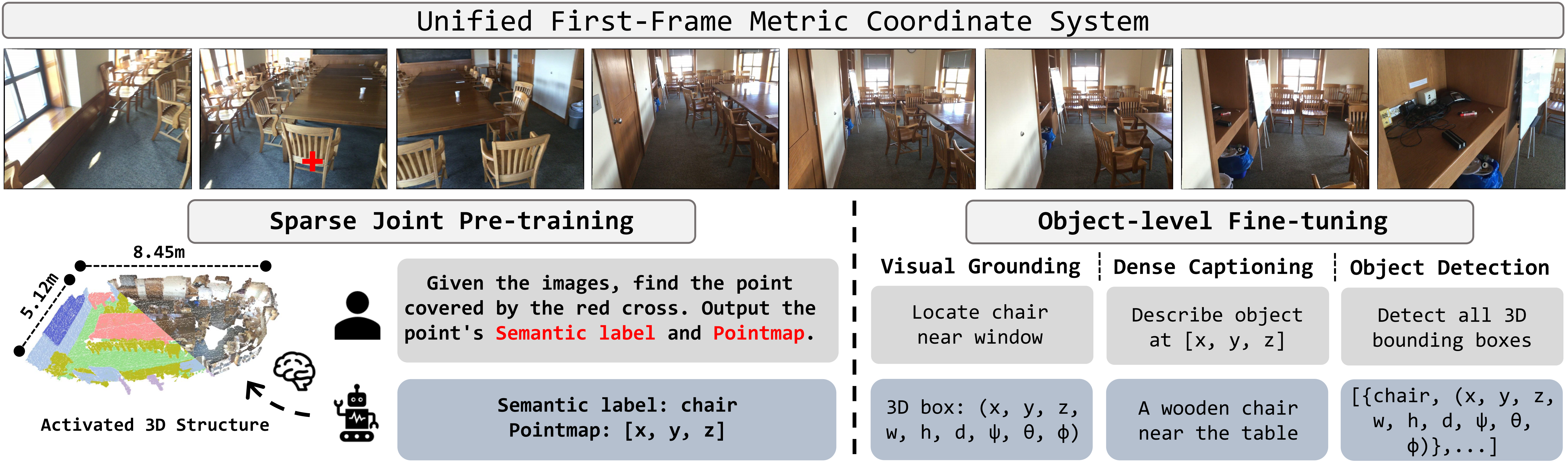
Geometry-aligned pre-training before downstream adaptation.

The training pipeline first activates spatial perception with sparse visual prompts, requiring the MLLM to predict both semantic labels and metric pointmaps. The model is then adapted to grounding, dense captioning, and 3D video object detection under a unified coordinate system.

GAP-MLLM training pipeline diagram

Results

Stronger RGB-only 3D perception across grounding, captioning, detection, and reconstruction.

53.1 ScanRefer Acc@0.25
84.7 Scan2Cap CIDEr@0.5
50.6 4-frame Detection F1@0.25
0.0616 Metric Overall Mean

Metric Reconstruction

Drag, zoom, and compare metric 3d reconstructions.

Input Images

CUT3R

CUT3R scene result

MapAnything

MapAnything scene result

GAP-MLLM

GAP-MLLM scene result

GT

Ground-truth scene result

3D Visual Grounding

Visualization of 3D visual grounding.

Legend for 3D visual grounding visualizations

3D Video Object Detection

Visualization of 3D video object detection.

Citation

BibTeX

@misc{zhang2026gapmllm,
      title={GAP-MLLM: Geometry-Aligned Pre-training for Activating 3D Spatial Perception in Multimodal Large Language Models}, 
      author={Jiaxin Zhang and Junjun Jiang and Haijie Li and Youyu Chen and Kui Jiang and Dave Zhenyu Chen},
      year={2026},
      eprint={2603.16461},
      archivePrefix={arXiv},
}